Learning and fun
Moon & Sky
The Moon's phases and five star patterns to find on a clear night, drawn from catalogue positions. English and Bulgarian, no sound.
For a family curious about the night sky. The cards show the Moon's phases, why a growing Moon is lit on the right, and five star patterns to look for on a clear night, from the Big Dipper and the Pole Star to Orion and the Summer Triangle. The star drawings follow catalogue positions; English and Bulgarian, with no sound.
How to use an activity · Create a multimedia pack
Try the activity
Version 1.0.1 · 188 KB · 12 items · 2 activities
Languages: en, bg · Resource licenses: CC0-1.0
Passive playback; optional touch. No sound.
Requires an updated Denframe host and card-capable viewer. Cast, Android and Nest hardware behavior remains unverified for these releases. Preview and silent reading work without sound permission.
From the Denframe Library · not part of the app. Add it to your Denframe, or download the file and choose Import a file in Studio → Library; there you can listen to its cards and show it on a screen. This website does not connect to or control your home.
Add it to your Denframe
Opens Moon & Sky in your own Denframe's Library, where you choose Get. Only its id is in the link: nothing about your home comes here.
In Denframe: Studio → Library → Get more → Add by id.
- Denframe in Home Assistant opens only through Home Assistant’s sidebar, which a link can’t reach: copy the id, then in Denframe choose Studio → Library → Get more → Add by id.
- The desktop app answers only on its own computer (127.0.0.1), at a port that can change: open Denframe from the app, then use Add by id.
- Your browser opens your Denframe’s address itself. Some browsers ask before a public website opens an address on your home network (Local Network Access): allow it, or use Add by id.
Keep the file: it is the exact signed release, and Import a file adds it again. There is no remote auto-updater.
Integrity and requirements
SHA-256: 6082d34b9b4ee2d8ae99d820808b082597b755ecc179507448e972b3aa85016a
- pack-format-v2
- reveal-sequence-v1
- card-v1
- pack-window-v1
- pack-audio-v1
How it plays
Each card shows its question, leaves a pause to recall the answer, then reveals it. A run goes through every card once.
- Moon and sky · English · 12 cards · the question for 9 s, 4 s to recall, the answer for 11 s · about 6 minutes in all
- Луната и небето · Bulgarian · 12 cards · the question for 9 s, 4 s to recall, the answer for 11 s · about 6 minutes in all
What's on the cards
All 12 cards, in English: the question, then the answer it reveals.
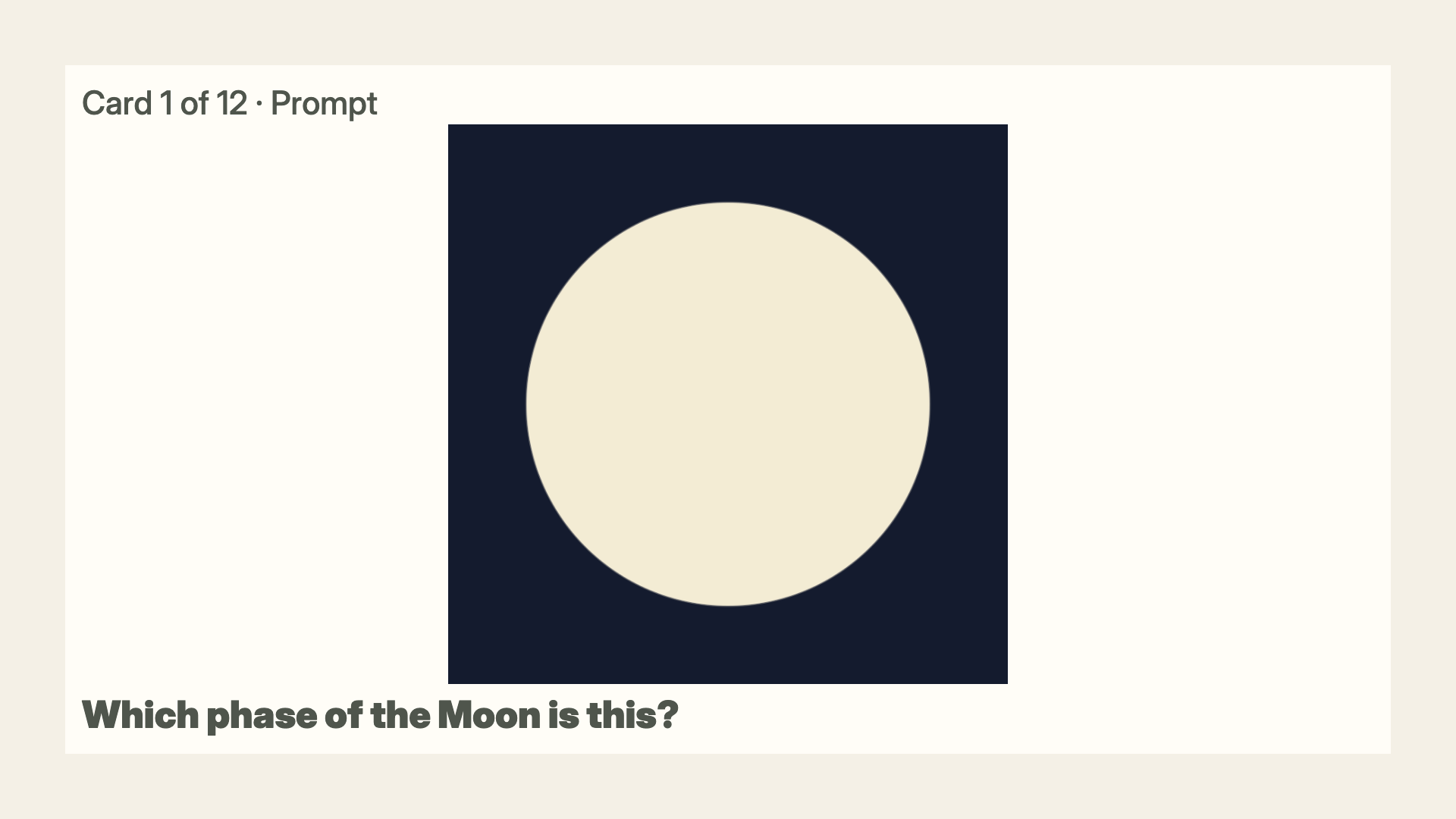
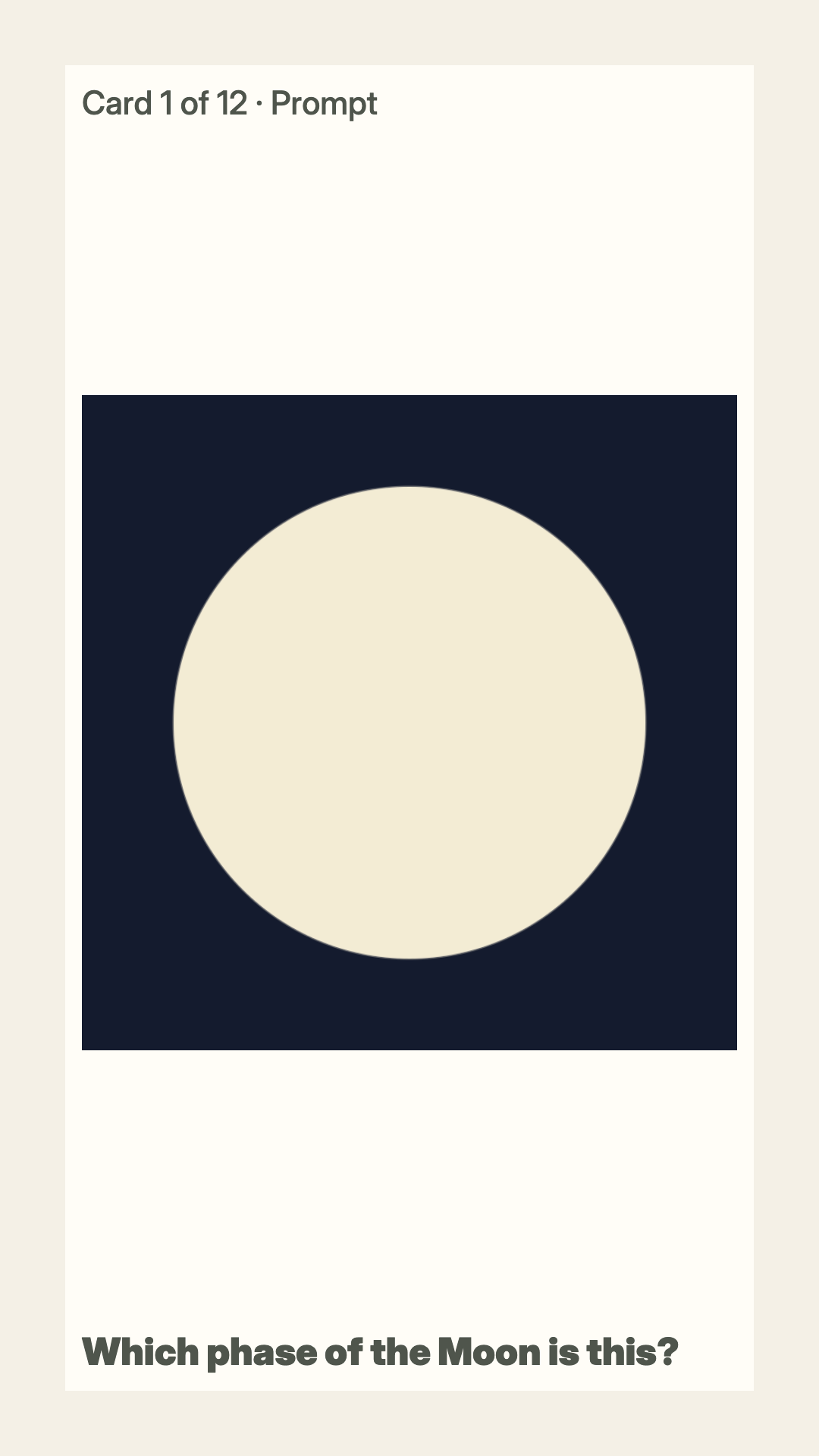
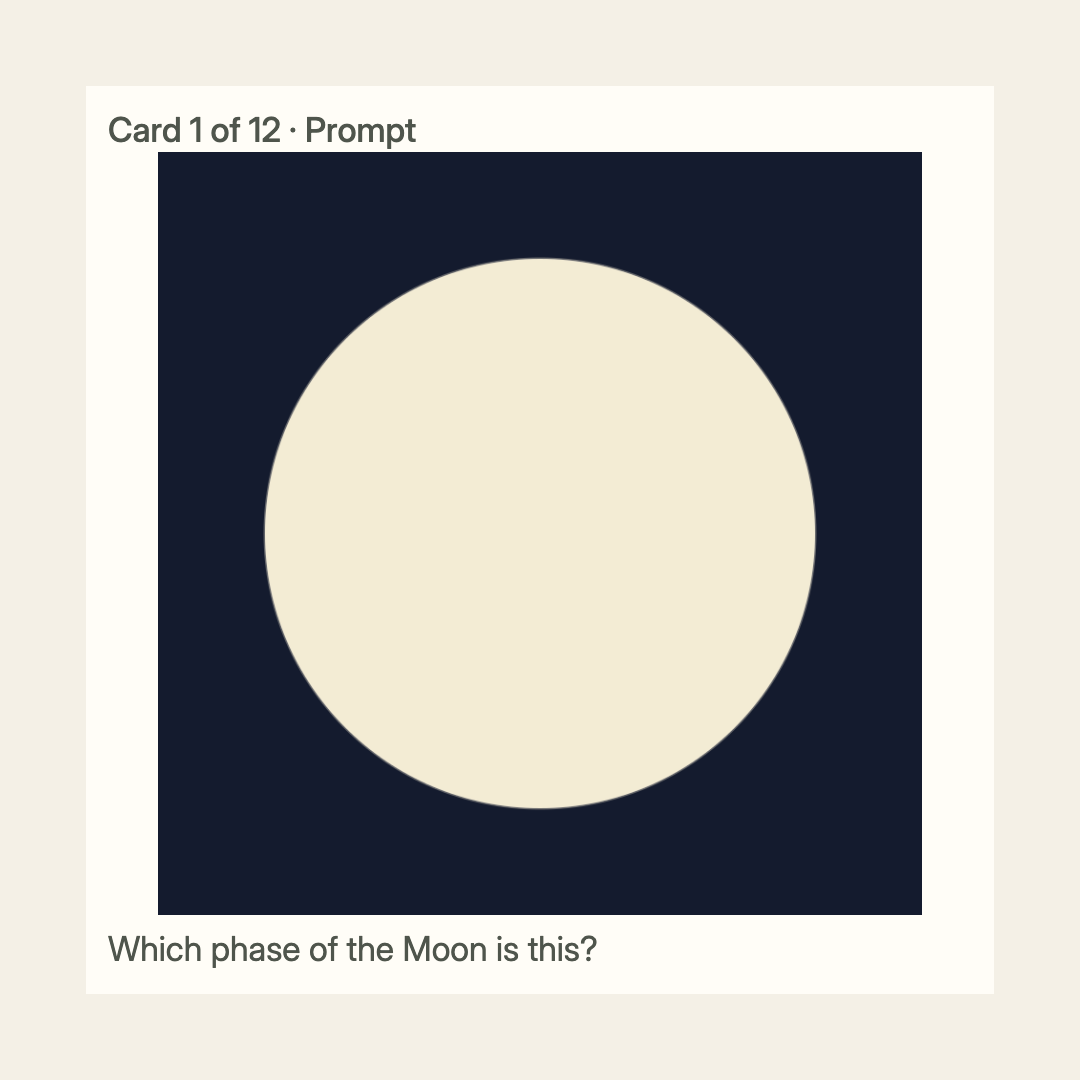
- Which phase of the Moon is this?Full moon. The whole side of the Moon that faces us is lit by the Sun.
- Which phase is this? The right half is lit.First quarter: half of the disc is lit, and the Moon is growing (waxing). Seen from the Northern Hemisphere, a growing Moon is lit on the right.
- A thin curve of light on the right. Is the Moon growing or shrinking?Growing. This is a waxing crescent: a few days after the new moon, the lit part gets bigger each night. (Seen from the Northern Hemisphere; south of the equator it is lit on the left.)
- More than half of the Moon is lit, on the right. What comes next?The full moon. This is a waxing gibbous Moon: it keeps growing until the whole face is lit. (Seen from the Northern Hemisphere; south of the equator it is lit on the left.)
- Which phase is this? The left half is lit.Last quarter (also called third quarter): half of the disc is lit, and the Moon is shrinking (waning). Seen from the Northern Hemisphere, a shrinking Moon is lit on the left.
- A thin curve of light on the left. What phase comes after it?The new moon, when we cannot see the lit side at all. This is a waning crescent, the last thin sliver before it. (Seen from the Northern Hemisphere; south of the equator it is on the right.)
- About how many days pass from one full moon to the next?About 29 and a half days. The Moon goes through all its phases in that time: new, crescent, quarter, gibbous, full, and back.
- Seven stars make a shape like a big ladle. What is it called?The Big Dipper, also called the Plough. It is part of the constellation Ursa Major, the Great Bear.
- Draw a line from the bottom of the bowl through its two end stars, out past the top of the bowl. Which star does it reach?Polaris, the North Star. It stays almost still above the northern horizon while the other stars turn around it.
- Five bright stars make a W (or an M). Which constellation is it?Cassiopeia. It sits on the other side of the North Star from the Big Dipper.
- Three stars in a short straight row are this hunter's belt. Who is he?Orion. Look for his belt, reddish Betelgeuse at one shoulder and bright blue-white Rigel at one foot.
- Three bright stars, each in a different constellation, make a big triangle on summer nights. What is it called?The Summer Triangle: Vega, Deneb and Altair.
Credits and review status
Original text was drafted for Denframe with AI assistance. Moon & Sky's pictures are original drawings made in code by Denframe (CC0). Star positions and brightness come from the SIMBAD database, operated at CDS, Strasbourg; the facts follow NASA Science. It has no sound. Downloaded files preserve their credits.
Publication approval: recorded. Content review passed.