Art collection
Patterns and textiles
Woven silks, printed cottons, embroideries, quilts, rugs, kimono and pattern designs from three centuries, chosen for their repeating patterns and colour on a tall screen.
Get the collection
Version 1.0.0 · 24 works · portrait · 10.0 MB to download, 10.0 MB on your Denframe
Works from Art Institute of Chicago and The Cleveland Museum of Art · public domain (CC0)
Choose it as a dashboard's background, where it changes picture through the whole collection, or as a picture block's source. Photos and art guide
From the Denframe Library · not part of the app. Add it to your Denframe, or download the file and choose Import a file in Studio → Library; it then appears under Backgrounds and in the picture picker. This website does not connect to or control your home.
Add it to your Denframe
Opens Patterns and textiles in your own Denframe's Library, where you choose Get. Only its id is in the link: nothing about your home comes here.
In Denframe: Studio → Library → Get more → Add by id.
- Denframe in Home Assistant opens only through Home Assistant’s sidebar, which a link can’t reach: copy the id, then in Denframe choose Studio → Library → Get more → Add by id.
- The desktop app answers only on its own computer (127.0.0.1), at a port that can change: open Denframe from the app, then use Add by id.
- Your browser opens your Denframe’s address itself. Some browsers ask before a public website opens an address on your home network (Local Network Access): allow it, or use Add by id.
Keep the file: it is the exact signed release, and Import a file adds it again. There is no remote auto-updater.
Integrity and requirements
SHA-256: d9b1ee5e3755cc1229c482cc44b75b20def6c03c57e0c5e3460317021451cfdb
- pack-format-v2
- gallery-pack-v1
The 24 works
In the order the collection plays them, each with what it shows. Every title links to the work's page at its museum.
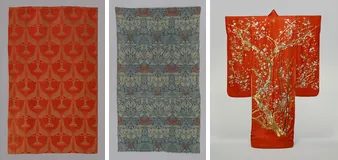
- Mohnköpfe (Poppyheads) (Dress or Furnishing Fabric) (opens in a new tab) · Designed by Koloman Moser (Austrian, 1868–1918) (Produced by Johan Backhausen und Söhne (Austrian, founded 1849), Austria, Vienna) · 1900 · Silk, wild silk, and cotton, warp-float faced 15:1 satin weave self-patterned by ground weft floats; woven on loom with Jacquard attachment; right selvage present · Art Institute of Chicago · CC0A length of red silk woven with a repeating pattern of stylised gold poppy seed heads in rows.
- Tulip and Rose (opens in a new tab) · Designed by William Morris (English, 1834–1896) (Produced by Morris & Co., London (English, 1875–1940), Probably woven by Heckmondwike Manufacturing Company, Yorkshire (English, founded 1873)) · Design 1876 · Four panels joined: wool, plain weave triple cloth · Art Institute of Chicago · CC0A woven wool fabric with a dense repeat of pale green tulips and leaves and small red roses on a dark blue-green ground.
- Furisode (opens in a new tab) · Japan · late Edo period (1789–1868), 1801/1868 · Silk, 4:1 satin damask weave (rinzu); embroidered with silk and gold-leaf-over-lacquered-paper-strip-wrapped silk in satin stitches; laid work and couching, and padded couching; lined with silk, plain weave · Art Institute of Chicago · CC0A red silk kimono embroidered with a gnarled gold plum tree covered in small white blossoms, displayed flat against a pale grey backdrop.
- Fragment (opens in a new tab) · Italy · 17th century · Linen, plain weave; embroidered with silk floss, and gilt- and silvered-metal-strip-wrapped silk in tent stitches; padded couching · Art Institute of Chicago · CC0A fragment of embroidered linen with a lattice of coral-pink diamonds framed by green, yellow and blue chevrons, crossed by interlaced bands of gold thread, its edges frayed.
- Panel (From a Dress) (opens in a new tab) · England, Spitalfields · c. 1745/46 · Silk, plain weave with patterning and brocading wefts · Art Institute of Chicago · CC0A cream silk dress panel scattered with small woven bouquets of pink roses and yellow flowers in tiny baskets.
- Panel (Dress Fabric) (opens in a new tab) · China · Qing dynasty (1644–1911), Mid–18th century · Silk, satin weave with brocading wefts and self-patterning complementary ground wefts bound in twill interlacings and self-patterned by areas of plain weave · Art Institute of Chicago · CC0A golden yellow silk woven with blue, pink and green peonies, leaves and white cloud-like scrolls.
- "Pincushion and Burrs" or "Square and Swallows" Quilt (opens in a new tab) · United States · c. 1830 · Cotton, plain weave, in parts (block?) printed; pieced; backed with cotton, plain weave; quilted and stitched in trapunto technique · Art Institute of Chicago · CC0A white quilt with navy blue four-pointed stars and leaf shapes and a border of navy triangles, finely quilted between.
- Kennett (opens in a new tab) · Designed by William Morris (English, 1834–1896) (Produced by Morris & Co., London (English, 1875–1940), Merton Abbey, London (English, 1881–1940)) · Design 1883, made 1887 · Silk, satin weave with self-patterning ground wefts · Art Institute of Chicago · CC0A pink silk fabric with a repeating pattern of large coral flowers on curling stems over a ground of small leaves.
- Panel (opens in a new tab) · Design in the style of Daniel Marot I (French, 1661–1752) or Jean Berain I (French, 1640-1711) (India, for the European market) · 1675/1727 · Cotton, plain weave; resist printed and painted · Art Institute of Chicago · CC0A pale cotton panel printed in soft blue with a symmetrical ornamental design of scrolls, a central star and a border of leaves.
- Length of Woven Silk (opens in a new tab) · France · Mid-1760s · Silk, plain weave foundation with supplementary patterning warps and supplementary patterning and brocading wefts of silk, gilt- and silvered-metal strips, wrapped and flat · Art Institute of Chicago · CC0A pale green silk woven with trailing garlands of pink and red roses and feathery white sprays.
- Suzani (large hanging or cover) (opens in a new tab) · Uzbekistan, probably Tashkent · 1840/1890 · Cotton, plain weave; embroidered with silk; pieced · Art Institute of Chicago · CC0A large embroidered hanging of rows of round red blossoms on vines around a central star, on a golden ground.
- Panel (opens in a new tab) · England · 1675/1700 · Linen and cotton, weft-float faced twill weave; embroidered with wool yarns in chain, detached chain, satin, single back, and stem stitches; French knots; edged with wool, twill woven tape · Art Institute of Chicago · CC0An embroidered panel of a winding tree with large curling green leaves, flowers, birds and small animals on cream linen.
- Length of Woven Silk (opens in a new tab) · France, Lyon · 1770-75 · Silk, warp-float faced 9:1 satin weave self-patterned by ground wefts · Art Institute of Chicago · CC0A crimson silk woven with vertical stripes of white flower sprays and green scalloped leaf bands.
- Karaori (Nô Costume) (opens in a new tab) · Japan · late Edo period (1789–1868), late 18th/early 19th century · Silk and gold-leaf-paper strips, twill weave; resist dyed; lined with silk, plain weave (replacement) · Art Institute of Chicago · CC0A Noh theatre robe of silk brocade in bands of pale blue, cream and gold, patterned with blue and lilac flowers and grasses.
- Panel (opens in a new tab) · France · c. 1724/27 · Silk, warp-float faced 7:1 satin weave with supplementary binding warps tying some three color complementary self-patterning ground wefts in plain interlacings · Art Institute of Chicago · CC0A pink silk panel woven with a large symmetrical design of silver-green leaves, fruit and flowers, with a small hole in its lower half.
- Printed Fabric (opens in a new tab) · Possibly manufactured by Oberkampf Manufactory (French, 1760–1843) (Jouy-en-Josas, France) · 1780s · Linen and cotton plain weave; block printed · Art Institute of Chicago · CC0A printed linen and cotton with a repeating pattern of red and pink flower heads and green leaves on a soft brown ground.
- Fragment (Dress Fabric) (opens in a new tab) · Iran (Persia) · 18th/19th century · Persian silk piece. Light silk; small flower spray · Art Institute of Chicago · CC0A fragment of magenta silk woven with close rows of small cream and pale blue flowering plants, its edges frayed.
- Length of Woven Silk (opens in a new tab) · Netherlands · 1730s · Silk, gilt-metal-strip-wrapped silk, warp-float faced 7:1 satin weave with supplementary brocading wefts and self-patterned by ground wefts; two selvages present · Art Institute of Chicago · CC0A woven silk with a symmetrical repeat of grey-green pagodas, vases and flowers on a warm brown ground.
- Panel (opens in a new tab) · Design in the style of Jean Revel (French, 1684–1751) (France, Lyon) · c. 1735 · Silk, plain weave with supplementary patterning warps and supplementary patterning and brocading wefts bound in weft-float faced 1:3 twill interlacings · Art Institute of Chicago · CC0A woven silk fragment with large pink peonies, green leaves and small blue flowers around tiny landscape scenes.
- Panel (Dress Fabric) (opens in a new tab) · France, Lyon or Italy, Venice · 1700/10 · Silk and gilt-metal-strip-wrapped silk, satin weave with twill interlacings of secondary binding warps and patterning and brocading wefts, and self-patterning ground wefts · Art Institute of Chicago · CC0A golden silk panel woven with small coloured flowers, leafy scrolls and pink lattice bands.
- Fragment (opens in a new tab) · Italy · 1450-1500 · Silk, plain weave with supplementary silk facing wefts, secondary binding warps tying supplementary gilt-metal-strip-wrapped silk patterning and brocading wefts forming weft loops in areas and supplementary pile warps forming cut voided velvet · Art Institute of Chicago · CC0A fragment of gold-brocaded silk velvet with a large pine-cone motif among curling leaves and flowers, outlined in crimson.
- Panel (opens in a new tab) · France or England · Early 18th century · Silk, gilt-metal strip, and gilt-metal-strip-wrapped silk (filé and frisé), plain weave with supplementary patterning wefts and brocading wefts and weft-float faced interlacing of secondary binding warps and some supplementary brocading wefts · Art Institute of Chicago · CC0A grey-green silk woven with trailing brown oak leaves and round pink and gold flower heads among white waves.
- Panel (From a Dress) (opens in a new tab) · England, Spitalfields · c. 1748/49 · Silk, plain weave with supplementary brocading wefts and self-patterned by complementary ground weft floats · Art Institute of Chicago · CC0A cream silk dress panel woven with scattered sprays of small red, pink and blue flowers and faint white leaves.
- New Suite of Portfolios of Flowers Ideal to Use for Designing and Painting: Floral Fantasies (opens in a new tab) · Anne Allen (British) · c. 1796 · color etching · The Cleveland Museum of Art · CC0A printed design of feathery ferns and fanciful flowers in orange, pink, green and lilac on pale paper.
Credits and review status
Every work is in the public domain under its museum's own CC0 release, resized for screens by Denframe. Each work's title, creator and museum also travel inside the file and show on its placard.
Publication approval: recorded.